You have finished repairing the wall, the drywall mud looks smooth, and the room is almost ready for a fresh coat of paint. At this stage, it is tempting to grab the roller as soon as the surface looks white and dry. But painting too early can turn a clean repair into a patchy finish, with visible joints, poor adhesion or moisture trapped beneath the coating.
For standard drying-type drywall joint compound, about 24 hours per coat under suitable conditions is a good general expectation. However, the final coat must be completely dry before sanding, priming or painting. High humidity, cool temperatures, thick applications and poor ventilation can push the drying time beyond 24 hours. In humid Indian weather—particularly during the monsoon—waiting 24–48 hours after the final coat may be more realistic.
The key is not simply counting hours. The drywall mud should be uniformly dry, properly sanded, dust-free and primed before the finish paint goes on.
Drywall Mud Drying Time: Quick Overview
| Situation | Typical Waiting Time |
|---|---|
| Thin coat of standard joint compound | Around 24 hours |
| Final coat before sanding | Wait until completely dry |
| Before primer | Usually at least 24 hours under normal conditions |
| High humidity | 24–48 hours or longer |
| Thick patches | May require more than 24 hours |
| Cool room | Drying takes longer |
| Good airflow and moderate temperature | Helps normal drying |
| Setting-type joint compound | Sets faster, but still needs to be dry before decorating |
| After sanding | Remove all dust before priming |
| Before finish paint | Prime drywall first and let primer dry as directed |
Is 24 Hours Long Enough for Drywall Mud to Dry?
In normal indoor conditions, 24 hours is commonly sufficient for a coat of conventional drying-type joint compound.
Major drywall manufacturer USG states that joint compound dries in about 24 hours under approximately 70°F (21°C) and 70% relative humidity. Higher humidity or lower temperatures increase the drying time.
That means the familiar “wait 24 hours” rule is useful—but not guaranteed.
Suppose you apply the final coat at 5 PM on Monday. Under good conditions, it may be ready for sanding on Tuesday evening.
But if the room is cool, closed and humid, the mud could still contain moisture.
Always judge the condition of the compound along with elapsed time.
Why Must Drywall Mud Be Completely Dry Before Painting?
Drywall compound contains water that needs to evaporate.
If primer or paint is applied while moisture remains in the compound, you risk an uneven finish and other decorating problems.
Manufacturers specifically require joint compound surfaces to be thoroughly dry before decorating. They should also be clean, dust-free and free from glossy areas.
This matters because fresh drywall has different surface materials.
The paper face of the plasterboard and the dried joint compound absorb coatings differently. Painting directly across both without correct preparation can leave visible patches or differences in sheen.
Patience during preparation usually saves much more time than repairing a bad paint finish later.
How Can You Tell When Drywall Mud Is Dry?
Colour is one of the easiest clues.
Wet joint compound usually looks darker than fully dried material. As it dries, it becomes lighter and more uniform.
Check thick areas carefully. Screw holes and thin feathered edges can dry quickly while deeper repairs remain damp underneath.
The surface should also feel hard rather than soft or cool and damp.
Do not sand mud that is obviously wet. Damp compound tends to smear or clog sandpaper rather than producing fine, dry sanding dust.
If there is any doubt, give it several more hours.
Does Humidity Increase Drywall Mud Drying Time?
Yes—sometimes considerably.
Drying-type joint compound hardens mainly as moisture leaves it. When the surrounding air already contains substantial moisture, evaporation happens more slowly.
This is particularly relevant during India’s monsoon season.
A drywall repair that comfortably dries overnight during a dry Delhi winter may take substantially longer in a poorly ventilated room during humid weather.
USG specifically notes that cold or wet conditions can require more than 24 hours for thorough drying.
Good ventilation helps remove moisture from the room. A fan can improve general air circulation, while air conditioning or a dehumidifier can help manage high indoor humidity.
Avoid blasting one wet patch with extreme heat, which may encourage uneven drying.
Does a Thick Layer of Drywall Mud Take Longer?
Absolutely.
A thin finishing coat has much less water to lose than a deep repair.
If you fill a large hole, deep joint or uneven area with a thick application of ready-mixed compound, the outside can appear dry while the centre remains damp.
This is one reason professional drywall finishing generally uses multiple controlled coats rather than one extremely thick layer.
Allow each coat to dry completely before applying the next. USG explicitly recommends complete drying between coats.
For deep repairs, expect drying to take considerably longer than the standard overnight period.
What About 20-, 45- or 90-Minute Joint Compound?
This is where DIY projects often become confusing.
Setting-type compounds—sometimes called “hot mud”—are sold according to approximate working or setting characteristics. Products may be labelled 20, 45 or 90, for example.
But setting and drying are not identical.
A compound can chemically set and become hard while still containing moisture.
Some specialised products allow much faster finishing. USG’s Durabond 90, for example, is designed for one-day drywall finishing and next-day decoration.
Always follow the specific compound manufacturer’s instructions instead of assuming a “45-minute” product can automatically be painted exactly 45 minutes after application.
Should You Prime Drywall Mud Before Painting?
Yes, priming is an important step for new drywall and repaired areas.
Joint compound and drywall face paper have different porosity. A suitable drywall primer helps create a more uniform surface before finish paint.
British Gypsum describes drywall primer as a product used after joint treatment to equalise suction and texture for painting. It also specifies that board and joint-treatment surfaces should be dry, clean and dust-free.
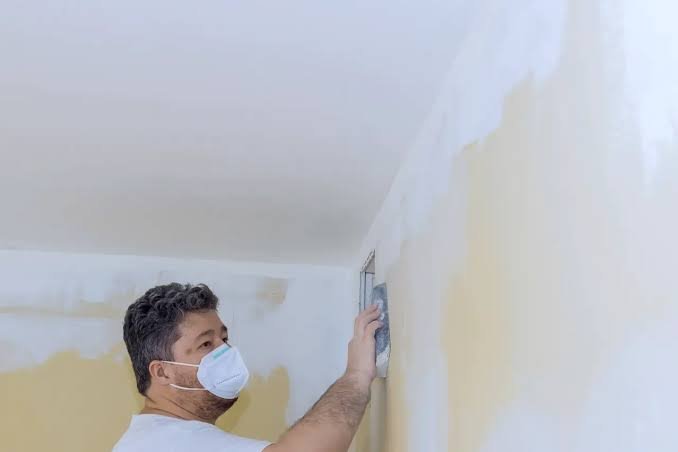
After sanding your final coat, remove the sanding dust thoroughly.
Then apply an appropriate drywall primer over the prepared surface. Let the primer dry for the period stated by its manufacturer before applying your finish paint.
Skipping primer may leave repaired areas visibly different from the surrounding wall, particularly under certain lighting conditions.
How Long After Sanding Can You Paint?
There is no special waiting period required simply because you sanded the wall.
The important issue is dust removal and priming.
Once completely dry drywall mud has been sanded smooth, inspect the repair under good lighting. Run your hand gently across the surface and check for ridges, pinholes or obvious transitions.
Remove all loose dust.
Then apply primer.
Once the primer has fully dried according to its product instructions, you can proceed with your chosen wall paint.
For the best finish, avoid trying to complete sanding, priming and multiple paint coats without respecting each product’s drying time.
A Practical Drywall Painting Schedule
Suppose you apply your final drywall mud coat on Saturday afternoon.
Allow it to dry overnight and through Sunday morning. Under normal conditions, approximately 24 hours may be sufficient. If humidity is high or the repair is thick, wait longer.
Once completely dry, sand the repair smoothly.
Remove every trace of loose sanding dust, inspect the surface and correct any imperfections. If another thin mud coat is required, apply it and restart the drying process rather than trying to hide the defect with paint.
When the finished surface is dry and smooth, apply drywall primer.
Allow the primer to dry according to its label, then apply the first finish coat. Respect the paint manufacturer’s recommended recoat time before adding the second coat.
The extra waiting may feel slow, but paint cannot compensate for drywall compound that was never properly dried or prepared.
FAQs
Q1. Can I paint drywall mud after 12 hours?
A. Sometimes a very thin coat may appear dry after 12 hours, but standard drying-type joint compound commonly requires around 24 hours under normal conditions. Do not rely on time alone; the compound should be completely dry before painting.
Q2. Can I paint directly over drywall mud without primer?
A. It is better to apply primer first. Drywall paper and joint compound absorb paint differently, which can result in visible patches or an uneven sheen. A suitable drywall primer helps create a more uniform surface for the finish paint.
Q3. Why is my drywall mud still wet after 24 hours?
A. Common causes include high humidity, low temperatures, poor ventilation, or a thick application of joint compound. Improve general airflow and allow additional drying time rather than sanding, priming, or painting while the compound is still damp.
Q4. How long should drywall mud dry during humid weather?
A. There is no fixed maximum drying time. While approximately 24 hours is common under favourable conditions, humid conditions may require 24–48 hours or longer, especially for thick patches. Wait until the entire repair is thoroughly dry before sanding, priming, and painting.