A great teacher can influence much more than examination marks. The right teacher can make a difficult subject understandable, encourage a student who lacks confidence, develop curiosity and sometimes even change the direction of a person’s career. India has a long tradition of respecting teachers as mentors, guides and builders of society, which is why Teachers’ Day continues to hold special importance across schools and colleges.
The meaning of a “famous teacher” has also expanded with time. Earlier, influential educators primarily reached students through classrooms, universities and educational institutions. Today, a teacher can reach millions through online classes, educational videos, digital learning platforms and social media.
The following list of the top 10 famous teachers in India in 2026 brings together historic educators and contemporary personalities associated with teaching and education. It is not an official ranking because their fields, generations and contributions are very different. Instead, it highlights educators whose work has had significant visibility or influence on learners in India.
Top 10 Famous Teachers in India 2026: Quick Overview
| Teacher / Educator | Known For | Main Area |
|---|---|---|
| Dr. Sarvepalli Radhakrishnan | Philosopher, Teacher & Former President | Philosophy & Education |
| Savitribai Phule | Pioneer of Women’s Education | Social & Educational Reform |
| Dr. A.P.J. Abdul Kalam | Scientist and Inspirational Educator | Science & Student Motivation |
| Rabindranath Tagore | Educational Thinker & Founder of Visva-Bharati | Literature & Education |
| Dr. Anand Kumar | Super 30 | Mathematics |
| Khan Sir | Popular Educational Teacher | Competitive Exams & General Studies |
| Alakh Pandey | Physics Wallah | Physics & Digital Education |
| Vikas Divyakirti | Civil Services Education | UPSC & Humanities |
| Avadh Ojha | Teaching & Student Motivation | Competitive Exams & General Studies |
| Ranjitsinh Disale | Innovative School Teacher | Primary Education & Educational Innovation |
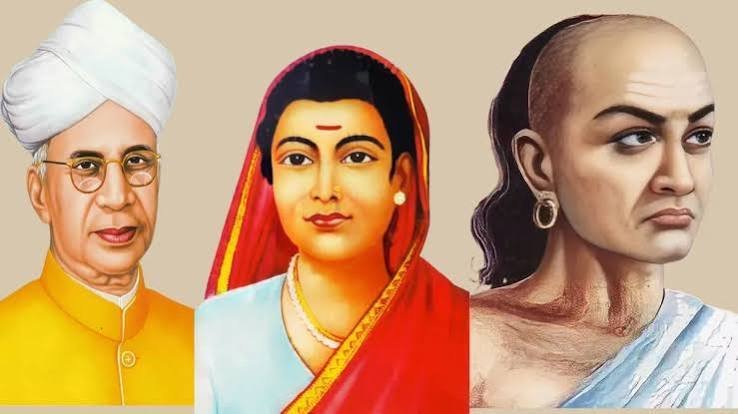
1. Dr. Sarvepalli Radhakrishnan
Few names are as closely associated with teaching in India as Dr. Sarvepalli Radhakrishnan.
He was a distinguished philosopher, academic, teacher and statesman who later became the second President of India. His academic work and commitment to education made him one of the country’s most respected intellectual figures.
His birthday, 5 September, is celebrated as Teachers’ Day in India.
Radhakrishnan’s educational legacy is associated with:
- Philosophy
- Higher education
- Intellectual development
- Teacher-student relationships
- Academic scholarship
- The social importance of teachers
His place on this list is not based on modern popularity but on his lasting symbolic importance to the teaching profession in India.
2. Savitribai Phule
Savitribai Phule occupies an extraordinary place in the history of Indian education.
At a time when educational opportunities for girls and marginalised communities were severely restricted, Savitribai Phule and Jyotirao Phule worked to expand access to education.
She is widely remembered as one of India’s pioneering women educators.
Her educational contribution is closely associated with:
- Girls’ education
- Social equality
- Access to learning
- Educational reform
- Women’s empowerment
Her work demonstrates that teaching can extend beyond explaining subjects inside a classroom.
Education can also become a means of challenging social barriers and expanding opportunities.
For modern students, Savitribai Phule’s story provides important historical context for educational access that is often taken for granted today.
3. Dr. A.P.J. Abdul Kalam
Dr. A.P.J. Abdul Kalam is primarily remembered as a scientist and former President of India, but teaching and interaction with students were also central to his public life.
He consistently encouraged young people to develop scientific curiosity, dream ambitiously and contribute to India’s development.
Even after holding the country’s highest constitutional office, Kalam remained deeply connected with educational institutions and students.
Students continue to associate him with:
- Science
- Innovation
- Discipline
- Curiosity
- National development
- Goal-setting
- Student motivation
His books and speeches remain widely read by young Indians.
Kalam’s influence demonstrates that a teacher does not always need to spend an entire career in a conventional classroom. The ability to make young people curious about learning can itself create a powerful educational legacy.
4. Rabindranath Tagore
Rabindranath Tagore is internationally famous as a poet and Nobel laureate, but his contribution to education is equally significant.
He developed an educational philosophy that questioned rigid classroom learning and placed greater emphasis on creativity, nature, culture and independent thinking.
Tagore established the institution that eventually became Visva-Bharati University at Santiniketan.
His approach emphasised:
- Learning beyond textbooks
- Creativity
- Literature
- Music and arts
- Nature
- Cultural exchange
- Independent thinking
Tagore believed education should develop the complete individual rather than simply prepare students to pass examinations.
That idea remains highly relevant in modern discussions about holistic education.
5. Anand Kumar
Anand Kumar became nationally famous through his Super 30 educational initiative in Bihar.
A mathematics educator, Kumar gained recognition for helping talented students from financially disadvantaged backgrounds prepare for highly competitive engineering entrance examinations.
His story became widely known through media coverage and later popular culture.
He is particularly associated with:
- Mathematics
- Competitive examination preparation
- Mentoring
- Education for disadvantaged students
- Engineering entrance preparation
His popularity illustrates an important feature of Indian education: a capable teacher can sometimes significantly change a student’s academic direction by making difficult concepts understandable and providing structured guidance.
His work also brought greater attention to questions of affordability and access in competitive examination coaching.
6. Khan Sir
Khan Sir has become one of the most recognisable teaching personalities in India’s digital education space.
Known for explaining topics in an energetic, conversational style, he gained a large following among students preparing for competitive examinations.
His teaching commonly covers areas connected with:
- General studies
- Current affairs
- Geography
- History
- Competitive examination topics
A major reason for his popularity is the use of everyday examples and relatively simple language to explain complicated topics.
His rise also reflects a broader transformation in Indian education.
A teacher no longer needs to depend only on a physical classroom to build a large student community. Digital platforms can allow a lesson taught in one city to reach learners throughout the country.
7. Alakh Pandey
Alakh Pandey is closely associated with the growth of Physics Wallah, which developed from online educational content into a major education platform.
He initially became widely known among students for teaching physics in an accessible style, particularly for competitive examination preparation.
His educational identity is strongly associated with:
- Physics
- JEE preparation
- NEET preparation
- Online learning
- Affordable digital education
His journey demonstrates how digital technology has changed the scale of teaching in India.
Recorded lessons, live classes, online test series and educational applications have made it possible for students outside major coaching hubs to access structured learning resources.
His prominence also reflects the growing importance of education technology in the country’s competitive-exam ecosystem.
8. Dr. Vikas Divyakirti
Dr. Vikas Divyakirti is a widely recognised name among students preparing for the UPSC Civil Services Examination.
He is associated with Drishti IAS and has become particularly popular for lectures that extend beyond examination preparation into subjects involving society, philosophy, ethics, language and decision-making.
Students often appreciate his structured and conversational teaching approach.
He is commonly associated with:
- UPSC preparation
- Hindi-medium education
- Essay and answer writing
- Ethics
- Humanities
- Student guidance
His popularity shows that modern students often expect teachers to do more than deliver information.
They also value teachers who help them understand how to think, analyse questions and communicate answers effectively.
9. Avadh Ojha
Avadh Ojha has become another well-known personality in India’s competitive-examination education space.
He is recognised particularly among civil-services aspirants for his teaching style and motivational discussions.
His educational content frequently connects academic preparation with subjects such as:
- History
- General studies
- Civil services preparation
- Discipline
- Goal-setting
- Student motivation
His popularity demonstrates how teaching and mentorship increasingly overlap in competitive-exam preparation.
However, students should remember that motivational content alone cannot replace a proper study strategy.
Successful preparation still requires syllabus coverage, revision, practice tests, answer writing and reliable learning material.
10. Ranjitsinh Disale
Ranjitsinh Disale represents a different side of famous teaching in India.
Rather than becoming known primarily through the coaching industry, he gained international recognition for innovative work as a school teacher in Maharashtra.
He became particularly well known after receiving the Global Teacher Prize in 2020.
His work has been associated with:
- Primary education
- Technology-assisted learning
- Innovative classroom practices
- Girls’ education
- Improving student engagement
His recognition is important because it highlights the impact teachers can create at the school level.
Innovation in education does not always require expensive infrastructure. Sometimes it begins with a teacher understanding the challenges faced by students and finding practical ways to make learning more accessible.
How Teaching in India Has Changed
The teachers on this list come from completely different generations, which makes the transformation of Indian education particularly visible.
Traditional teaching was primarily centred around:
- Schools
- Colleges
- Universities
- Physical coaching centres
Modern teachers can additionally use:
- YouTube
- Educational apps
- Live online classes
- Recorded courses
- Digital notes
- Online test platforms
This has dramatically increased the potential reach of individual educators.
However, technology does not automatically create good teaching.
Regardless of the platform, an effective teacher still needs strong subject knowledge, clarity, patience, communication skills and an ability to help students think independently.
What Makes a Teacher Truly Influential?
Popularity and teaching quality are not always identical.
A teacher can have millions of online followers, while another teacher may quietly transform the lives of a few hundred students over an entire career.
Some qualities that make teachers genuinely influential include:
- Strong subject knowledge
- Clear explanations
- Patience
- Ability to encourage questions
- Respect for students
- Adaptability
- Ethical behaviour
- Genuine interest in learning
Ultimately, India’s most valuable teachers are not necessarily only those whose names become famous. Thousands of school teachers, professors and mentors make important contributions every day without receiving national recognition.
FAQs
Q1. Who is considered one of the most famous teachers in Indian history?
A. Dr. Sarvepalli Radhakrishnan is among the most prominent names associated with teaching in India. His birthday on 5 September is celebrated as Teachers’ Day across the country.
Q2. Who are some famous online teachers in India?
A. Khan Sir, Alakh Pandey and other digital educators have developed large student communities through online learning. Their popularity particularly reflects the growth of competitive-exam and technology-enabled education.
Q3. Why is Savitribai Phule important in Indian education?
A. Savitribai Phule was a pioneering educator who worked to expand educational opportunities for girls and marginalised communities during the 19th century. Her contribution remains an important part of India’s educational and social-reform history.
Q4. Should students choose a teacher based on online popularity?
A. No. Popularity can help students discover teachers, but the final choice should depend on teaching clarity, subject accuracy, syllabus relevance and whether the teaching style matches the student’s learning needs. Students preparing for competitive examinations should also rely on the official syllabus and appropriate practice material.