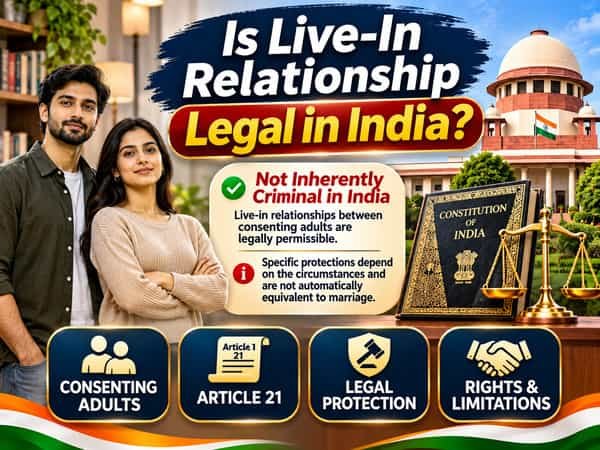
Is live-in relationship legal in India? Yes, living together without marriage isn’t an offence, and the Supreme Court has said so since 2010, but it isn’t a marriage either, and Uttarakhand and Gujarat now require couples to register. Rights depend on whether the relationship counts as “in the nature of marriage.” This is general information, not legal advice.
Quick Facts
| Question | Short answer | Basis |
| Is it legal for adults to live together? | Yes, not an offence | S. Khushboo v. Kanniammal, 2010 |
| Is there a “live-in relationship law”? | No single statute | Rights come from judgments and the DV Act |
| Is protection available against domestic violence? | Yes, if “in the nature of marriage” | Domestic Violence Act, 2005, Section 2(f) |
| Can a woman claim maintenance? | Courts have allowed it in long-term, marriage-like relationships | Section 125 CrPC, now Section 144 BNSS |
| Is registration required? | In Uttarakhand and Gujarat, yes | State UCC laws |
| Penalty for not registering | Up to 3 months’ jail, ₹10,000 fine, or both | Uttarakhand and Gujarat UCC |
The Short Answer
The law tolerates and, in some cases, protects live-in relationships without treating them as marriages.
- One guide says there is no central legislation that specifically registers or governs live-in relationships
- Legal Service India notes that partners don’t have the same legal rights as married couples, but are entitled to some protection under certain laws
- The Supreme Court has repeatedly held that two consenting adults living together is neither a crime nor a sin, according to one 2026 guide
What the Supreme Court Has Held
A handful of cases carry the law.
- Khushboo v. Kanniammal (2010): a live-in relationship between consenting adults isn’t illegal and is protected under Article 21
- Velusamy v. D. Patchaiammal (2010): set conditions for a “relationship in the nature of marriage,” including that the couple hold themselves out as spouses, are of legal age and qualified to marry, and live together voluntarily for a significant period
- Indra Sarma v. V.K.V. Sarma (2013): not every live-in relationship qualifies, and where the woman knew her partner was already married, the relationship wasn’t “in the nature of marriage”
- An older line of cases holds that long cohabitation raises a presumption of marriage, and that such relationships can’t be dismissed as “walking in and walking out”
When It Counts as “In the Nature of Marriage”
This phrase decides which rights you can claim.
- Merely spending weekends together or a one-night stand wouldn’t make a “domestic relationship,” according to the Velusamy criteria
- Stability, continuity, shared responsibilities and mutual commitment are what courts look for
- Being aware that the partner is married can defeat a claim, as in Indra Sarma
- Evidence of living together, shared finances and public acknowledgement matters, since there’s no certificate unless a state requires one
Protection and Maintenance
The rights that apply are civil, and they favour women in qualifying relationships.
- The Domestic Violence Act, 2005 offers protection orders, residence orders, monetary relief, custody orders and compensation orders. It doesn’t criminalise the relationship
- Maintenance has been granted to women in long-term relationships that resemble marriage, under Section 125 CrPC, now Section 144 BNSS
- One reported 2026 Supreme Court ruling by Justices Nagarathna and Bhuyan held that ending a consensual live-in relationship isn’t a criminal offence and allowed maintenance for the child. It comes from a current-affairs site, so I couldn’t verify it against the judgment
- A government statement in Parliament affirmed that women in marriage-like live-in relationships are entitled to protection under the DV Act, according to one article
Uttarakhand’s UCC
The first state to require registration.
- Uttarakhand’s Uniform Civil Code has operated since 27 January 2025, and it made registration of live-in relationships mandatory
- Anyone staying in a live-in relationship for over a month without making a statement faces up to three months’ imprisonment or a fine up to ₹10,000 or both
- Providing false information can bring up to three months and ₹25,000, and ignoring a registrar’s notice can bring up to six months and ₹25,000
- Partners must be at least 18, and parents or guardians are informed if either is under 21
- Early reports of the bill said 3 to 6 months or ₹25,000 for failing to register, which differs from the enacted figures, so use the later sources
Gujarat, Assam and the 2026 Changes
More states have followed.
- A report published a day ago says Gujarat and Assam have now enacted their own UCC laws
- The Gujarat UCC Act, 2026 was passed on 24 March and excludes same-sex couples from its marriage and live-in provisions
- In Uttarakhand and Gujarat, a couple living together in the state must file a statement even if neither is a resident
- Both forward statements to the local police station, though Uttarakhand removed a related clause in 2026
- The same report says Uttarakhand’s 2026 amendment provides up to seven years’ imprisonment for obtaining consent by force, coercion or fraud, and for certain relationships involving a person already married or in another live-in relationship, while Gujarat’s maximum is five years
How Many Have Registered
Uptake has been low.
- By July 2025, about 90 live-in relationships had been registered in Uttarakhand against over two lakh marriages, according to the Tribune
- In 72% of those live-in registrations, children were also documented and would have the same rights as children of married couples
- A live-in couple has challenged the requirement in a case reported as “We Owe Nothing to the State,” and constitutionality is described as contested
What You Don’t Get
Live-in status doesn’t confer everything marriage does.
- No automatic spousal rights on maintenance, unless the relationship qualifies as marriage-like
- No marriage certificate, so proof depends on evidence
- A claim against a married partner may fail if you knew of the marriage
- Check how inheritance and property work in your state, since I found no clear sourced rule
Practical Tips
A few steps reduce risk.
- Keep records of living together, such as joint tenancy, bills, bank statements and photographs
- Check whether your state requires registration, particularly in Uttarakhand and Gujarat
- Consider a written cohabitation agreement on property and expenses, and a will if you want to provide for your partner
- Get legal advice before relying on a right, since outcomes depend on the facts
FAQs
Q1. Is a live-in relationship legal in India?
A. Yes. The Supreme Court held in 2010 that consenting adults living together isn’t an offence, though no single law governs it.
Q2. Do live-in partners have the same rights as married couples?
A. No. They have limited protection, such as under the Domestic Violence Act and maintenance, if the relationship is “in the nature of marriage.”
Q3. Is registration mandatory?
A. In Uttarakhand and Gujarat, yes. Staying together for over a month without a statement can mean up to three months in jail or a ₹10,000 fine.
Q4. Can a woman get maintenance from a live-in partner?
A. Courts have granted it in long-term, marriage-like relationships under Section 125 CrPC, now Section 144 BNSS, depending on the facts.