You fed your sourdough starter in the morning, watched it rise beautifully by afternoon, and by bedtime it had already collapsed. Does that mean it is hungry again? Should you feed it once a day, twice a day, or every time it falls? For beginners, sourdough feeding schedules can quickly feel more complicated than making the bread itself.
The simple answer is: an active sourdough starter kept at room temperature generally needs feeding once every 24 hours, although twice-daily feeding—about every 12 hours—can be useful for a very active starter or when preparing it for baking. A starter stored in the refrigerator needs far less attention and can commonly be maintained with a feeding about once a week.
For Indian home bakers, temperature makes a particularly big difference. A starter sitting in a warm kitchen in Delhi, Mumbai or Chennai can ferment much faster than one kept in a cool air-conditioned room. Instead of following the clock blindly, learn to read how quickly your starter rises, peaks and begins falling.
Sourdough Starter Feeding Schedule: Quick Overview
| Starter Condition | Practical Feeding Schedule |
|---|---|
| Active starter at room temperature | About once every 24 hours |
| Very active starter | Every 12 hours if needed |
| Starter being strengthened before baking | Often every 12 hours |
| Starter stored in refrigerator | About once a week |
| Warm Indian kitchen | May require larger feeds or more frequent feeding |
| Cool kitchen | Fermentation will generally be slower |
| Starter rises and collapses very quickly | Adjust feeding ratio or frequency |
| Starter taken from refrigerator for baking | Give several room-temperature feeds until reliably active |
| New starter still developing | Follow the creation schedule rather than mature-starter maintenance |
How Often Should You Feed a Room-Temperature Starter?
For an established starter kept permanently on your kitchen counter, once-daily feeding is a convenient maintenance routine.
A common approach uses a 1:1:1 ratio by weight. For example:
50 g starter + 50 g water + 50 g flour
After feeding, a healthy starter begins producing bubbles and expanding. A mature, vigorous starter may roughly double within 6–8 hours, although temperature, flour and feeding ratio can change the timing considerably.
If you bake very frequently or want to keep the starter particularly vigorous, you can feed it twice daily, roughly 12 hours apart.
There is no prize for feeding more frequently than necessary. Your goal is to maintain predictable fermentation without wasting excessive flour.
How Do You Know When Your Starter Is Hungry?
Your starter’s appearance often tells you more than the clock.
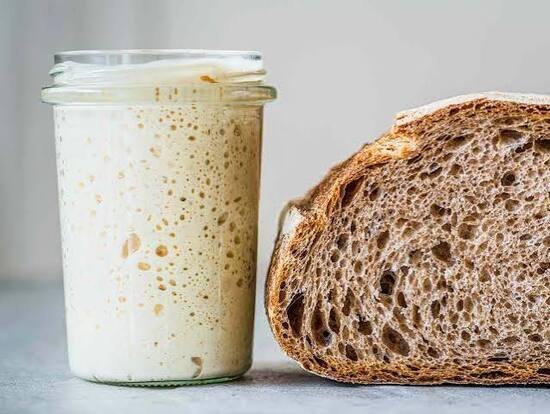
Immediately after feeding, the mixture sits relatively low in the jar. As microorganisms ferment the fresh flour, bubbles develop and the starter expands.
Eventually, it reaches its peak. The top may look slightly rounded, the mixture should be visibly aerated and its volume may have doubled or more.
After exhausting much of its available food, the starter begins falling.
If it repeatedly peaks and completely collapses long before the next scheduled feed, your feeding schedule or ratio may need adjusting.
A strong acetone-like or nail-polish-remover smell can also appear when a starter is very hungry. Feeding normally and consistently will often restore a more pleasant tangy aroma.
Why Indian Kitchen Temperature Changes Everything?
Temperature has a major influence on sourdough fermentation.
In a kitchen around 20–22°C, a starter may develop relatively slowly. At 27–30°C, activity can accelerate considerably.
This creates an important issue for Indian home bakers.
Suppose you feed your starter at 8 AM using a 1:1:1 ratio. During a hot summer day, it might rise, peak and begin collapsing much earlier than expected. Feeding exactly the same starter in a cool December kitchen could produce a much slower response.
If your kitchen is hot and your starter is consuming its food too quickly, you do not necessarily need to start feeding it three or four times a day. A more practical solution is to increase the feeding ratio.
For example, moving from 1:1:1 to 1:2:2 or 1:4:4 provides more fresh flour and water relative to the amount of old starter. A larger feed generally takes longer to ferment.
Using cooler water can also help moderate fermentation in a hot kitchen.
Should You Feed an Active Starter Every 12 Hours?
Sometimes, yes.
Twice-daily feeding is particularly useful when you are trying to build a strong starter before making naturally leavened bread.
For example, if your refrigerated starter has been inactive for several days, take it out a day or two before baking and begin feeding it at room temperature.
You might feed it in the morning and again approximately 12 hours later. Continue until it behaves predictably and can roughly double within 6–8 hours after feeding.
Once the starter is strong again, use it near its ripe stage according to your bread recipe.
You do not have to maintain this twice-daily schedule forever. After baking, a casual baker can feed the remaining starter and return it to refrigerator maintenance.
When Is the Best Time to Use Starter for Baking?
Ideally, use active starter when it is ripe—around its peak or shortly afterwards, depending on the recipe.
A ripe starter should look bubbly and expanded. A strong starter commonly doubles within roughly 6–8 hours after feeding under suitable room-temperature conditions.
An easy trick is to put a rubber band around the jar immediately after feeding. Position it at the starter’s starting level.
You can then clearly see how far the mixture has risen.
Instead of thinking, “I fed it six hours ago, so it must be ready,” look for actual fermentation activity. The starter’s behaviour is more reliable than an exact number of hours.
What If You Bake Only Once a Week?
There is little reason to feed starter every day if you bake only occasionally.
Store it in the refrigerator.
Cold temperatures dramatically slow fermentation, allowing a mature starter to be maintained with approximately one feeding per week.
After feeding, allow it some time at room temperature so fermentation begins, then return it to the refrigerator.
A day or two before your planned baking session, take it out and give it a couple of room-temperature feedings. Continue until it becomes reliably bubbly and rises strongly after feeding.
This routine can save a substantial amount of flour compared with maintaining a large countertop starter every day.
What Happens If You Forget to Feed Your Starter?
Missing one feeding does not usually mean your established starter is dead.
A neglected starter may collapse completely, become highly acidic or develop liquid on top. It may also smell unusually strong.
Give it fresh flour and water and observe its response. A mature starter can often recover after several regular feedings.
However, visible mould or unusual pink, orange or otherwise suspicious discolouration is different. Do not simply stir obvious mould into fresh flour and continue using the starter. When contamination is evident, discarding the starter is the safer approach.
Do You Need to Discard Starter Every Time You Feed It?
For routine maintenance, removing some starter before feeding keeps the quantity manageable and maintains your intended feeding ratio.
Imagine keeping 100 g of starter and adding another 100 g each of flour and water every day without removing anything. The amount would rapidly become enormous.
Instead, keep a smaller portion—perhaps 20–50 g—and feed that.
Discard does not necessarily need to go into the bin. Properly maintained sourdough discard can be used in recipes such as pancakes, crackers, pizza dough, waffles and flatbreads.
Keeping a small starter is one of the easiest ways to reduce flour waste.
A Simple Feeding Routine for Beginners
If you have a healthy mature starter and bake regularly, choose one fixed time each day.
For example, at 8 AM, retain 30 g of starter and add 30 g water plus 30 g flour for a 1:1:1 feed. Mark its starting level and observe when it peaks.
If it consistently peaks extremely early and becomes exhausted long before the next morning, increase the feeding ratio or consider twice-daily feeding.
If you bake only on weekends, refrigerating the starter is usually more convenient.
Do not constantly change the flour, feeding ratio, water temperature and schedule at the same time. Keep a simple routine for several days so you can understand how your particular starter behaves.
FAQs
Q1. Is feeding sourdough starter once a day enough?
A. Yes. A healthy mature starter maintained at room temperature can commonly be fed approximately once every 24 hours. Very active starters or starters being strengthened for baking may benefit from twice-daily feeding.
Q2. Should I feed sourdough starter every 12 or 24 hours?
A. Both schedules can work. Daily feeding is convenient for routine countertop maintenance, while 12-hour feeding can help maintain vigorous activity or prepare a starter for baking. Temperature and feeding ratio should also guide your decision.
Q3. How often should I feed sourdough starter in hot Indian weather?
A. Watch how quickly it peaks. Warm kitchens accelerate fermentation, so a 1:1:1 starter may become hungry well before 24 hours. Instead of constantly feeding it, consider a larger ratio such as 1:2:2 or 1:4:4, use cooler water, or refrigerate it if you bake infrequently.
Q4. How do I know my starter is ready to bake with?
A. A healthy starter should become bubbly and rise strongly after feeding. A commonly used benchmark is roughly doubling within 6–8 hours at room temperature. For best leavening performance, recipes generally use starter when it is ripe—around its maximum rise or shortly afterwards.