India’s reading culture is as diverse as its languages, regions and generations. A reader browsing a bookstore today might pick up a novel written before Independence, an English-language bestseller about modern relationships, a historical novel, or a translated work originally written in an Indian language. Yet only a small number of books continue to remain familiar long after their first publication.
Some books become famous because they win major literary awards. Others capture an important period of Indian history, introduce unforgettable characters or make complex social issues accessible to ordinary readers. A few become so deeply connected with popular culture that even people who have never read them recognise their titles and authors.
The top 10 famous books and authors in India listed below represent different generations and styles of Indian writing. They include literary classics, modern novels, historical fiction and popular contemporary works. This is not an official 1–10 ranking; instead, it is a practical selection based on enduring recognition, cultural influence and popularity among Indian readers.
Quick Overview
| Book | Author | Particularly Known For |
|---|---|---|
| The Guide | R. K. Narayan | Indian Life & Human Relationships |
| Train to Pakistan | Khushwant Singh | Partition of India |
| Midnight’s Children | Salman Rushdie | Independence & Postcolonial India |
| The God of Small Things | Arundhati Roy | Family, Society & Kerala |
| A Suitable Boy | Vikram Seth | Family, Marriage & Post-Independence India |
| The White Tiger | Aravind Adiga | Class, Ambition & Social Inequality |
| The Palace of Illusions | Chitra Banerjee Divakaruni | Mahabharata Retelling |
| The Immortals of Meluha | Amish Tripathi | Mythological Fiction |
| Five Point Someone | Chetan Bhagat | College Life & Academic Pressure |
| Malgudi Days | R. K. Narayan | Everyday Indian Life |
1. The Guide – R. K. Narayan
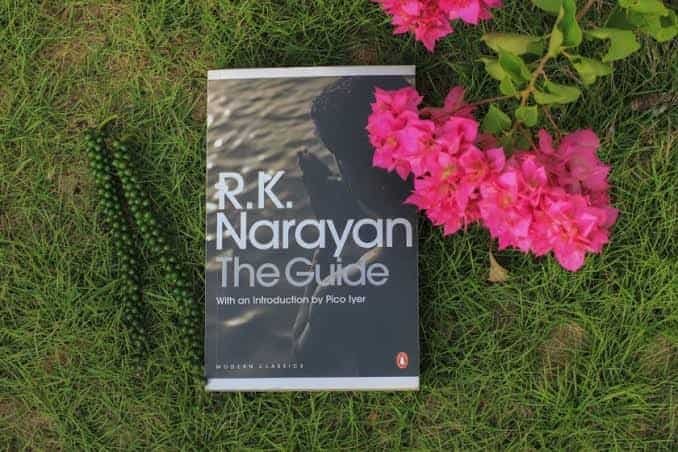
R. K. Narayan occupies a special place in Indian English literature, and The Guide is among his most celebrated novels.
The story centres on Raju, a man whose life changes dramatically as he moves through different identities and relationships. What begins with relatively ordinary circumstances gradually develops into a deeper exploration of human behaviour, responsibility and transformation.
The novel is appreciated for:
- Simple yet effective English
- Memorable characters
- Indian social settings
- Human relationships
- Moral complexity
- Gentle humour
Narayan’s writing is particularly accessible because he could portray everyday Indian life without making it unnecessarily complicated.
For readers beginning to explore classic Indian English fiction, The Guide remains an excellent starting point.
2. Train to Pakistan – Khushwant Singh
Few events have shaped modern South Asian history as deeply as the Partition of India in 1947.
Khushwant Singh’s Train to Pakistan approaches this enormous historical event through the experiences of ordinary people.
Instead of focusing only on political leaders and high-level decisions, the novel examines how communal violence and displacement affect a village and the people living there.
The book explores:
- Partition
- Communal tension
- Human relationships
- Violence and displacement
- Moral choices
- Love and sacrifice
Its strength comes from making a major historical tragedy personal.
For younger readers who know Partition primarily through textbooks, the novel offers a literary perspective on the human consequences behind historical dates and statistics.
3. Midnight’s Children – Salman Rushdie
Salman Rushdie’s Midnight’s Children is one of the most internationally recognised novels connected with modern Indian history.
The novel links the life of its central character, Saleem Sinai, with India’s journey through Independence and the decades that follow.
Rushdie combines history with imagination, symbolism and magical realism.
The book is known for:
- Indian Independence
- Postcolonial identity
- Politics
- Family history
- Magical realism
- Experimental storytelling
Midnight’s Children won the Booker Prize and later received additional recognition connected with the award’s history.
It can be more demanding than conventional commercial fiction, but readers interested in literary writing, history and unconventional storytelling may find it particularly rewarding.
4. The God of Small Things – Arundhati Roy
Arundhati Roy’s debut novel The God of Small Things became an international literary success and won the Booker Prize in 1997.
Set largely in Kerala, the novel follows a family while examining relationships, childhood experiences and social structures.
Its themes include:
- Family
- Childhood
- Love
- Social hierarchy
- Caste
- Memory
- Social expectations
Roy’s language and narrative structure are distinctive, with the story moving across time rather than following a completely straightforward chronological path.
The novel demonstrates how personal family stories can reflect much larger questions about society.
For readers interested in serious literary fiction, it remains one of India’s most recognised modern novels.
5. A Suitable Boy – Vikram Seth
Vikram Seth’s A Suitable Boy is famous partly because of its extraordinary scale.
Set in post-Independence India, the novel follows multiple families while its central storyline involves the search for a suitable marriage for Lata.
But describing it simply as a marriage story would miss much of its depth.
The novel explores:
- Family relationships
- Marriage
- Religion
- Politics
- Social expectations
- Post-Independence India
Its large cast of characters and detailed portrayal of society make it an ambitious reading experience.
For Indian readers, many of its conversations about family expectations, marriage and individual choice remain surprisingly relatable despite the historical setting.
6. The White Tiger – Aravind Adiga
The White Tiger by Aravind Adiga presents a darker examination of economic inequality, ambition and social mobility in modern India.
The novel follows Balram Halwai as he attempts to escape the limitations of his circumstances.
Through his perspective, the story examines differences between wealth and poverty and raises uncomfortable questions about opportunity and power.
Important themes include:
- Class inequality
- Ambition
- Urban India
- Economic change
- Power
- Social mobility
The novel won the Booker Prize in 2008.
Its portrayal of India is intentionally sharp and critical, so readers should understand it as a fictional perspective rather than a complete representation of Indian society.
7. The Palace of Illusions – Chitra Banerjee Divakaruni
Indian mythology has inspired countless books, films and television series, but modern writers increasingly reinterpret familiar stories through different perspectives.
Chitra Banerjee Divakaruni’s The Palace of Illusions retells elements of the Mahabharata primarily through the perspective of Draupadi.
This shift allows familiar events to be explored through questions involving:
- Women’s perspectives
- Power
- Marriage
- Identity
- Family
- Destiny
- War
Readers who already know the broad Mahabharata narrative may find the changed viewpoint particularly interesting.
The book helped strengthen the popularity of modern mythological retellings among English-language readers in India.
8. The Immortals of Meluha – Amish Tripathi
The Immortals of Meluha helped make mythological fiction a major category in India’s contemporary commercial book market.
Written by Amish Tripathi, the novel presents an imaginative fictional interpretation involving Shiva.
Rather than simply retelling a traditional scripture, the book builds an alternative fictional world inspired by mythology.
Readers often appreciate it for:
- Fast-paced storytelling
- Mythology-inspired fiction
- Adventure
- World-building
- Accessible language
- Philosophical questions
The book became the first part of Amish’s Shiva Trilogy and contributed significantly to his popularity.
Its success also demonstrated the large Indian readership available for stories that combine traditional cultural material with modern commercial-fiction techniques.
9. Five Point Someone – Chetan Bhagat
When Five Point Someone appeared, its setting and conversational writing style appealed strongly to young Indian readers.
Chetan Bhagat’s novel follows engineering students dealing with academics, friendships, relationships and the pressure surrounding performance at a prestigious institution.
Its themes include:
- College life
- Academic pressure
- Friendship
- Career expectations
- Relationships
- Student identity
The novel became commercially successful and contributed to a broader shift towards accessible English-language fiction aimed at India’s growing young readership.
Bhagat’s writing style has generated different opinions among literary critics and readers, but his influence on Indian popular publishing is difficult to ignore.
His books helped bring many occasional readers into mainstream English fiction.
10. Malgudi Days – R. K. Narayan
R. K. Narayan appears twice on this list because Malgudi Days has developed an identity of its own within Indian popular culture.
Rather than being a single novel, it is a collection of short stories set in the fictional South Indian town of Malgudi.
The stories focus on ordinary people—children, workers, families and other characters dealing with everyday situations.
The collection is known for:
- Simple storytelling
- Everyday Indian life
- Humour
- Human behaviour
- Small-town settings
- Memorable characters
The television adaptation of Malgudi Days further increased its recognition across India.
For new readers, short stories also make the book easier to approach than a long novel.
Why Do Some Books Remain Famous for Generations?
Commercial success can make a book popular for a few months, but lasting recognition requires something more.
Books often survive across generations because they contain themes readers continue to understand.
These may include:
- Family relationships
- Love
- Ambition
- Social inequality
- Identity
- History
- Friendship
- Conflict
- Personal freedom
Historical context also matters.
Train to Pakistan continues to be discussed because Partition remains central to understanding modern Indian history. Five Point Someone, meanwhile, connected with students experiencing academic and career pressure.
Different books survive for different reasons.
How to Start Reading Famous Indian Books
Readers do not need to begin with the longest or most critically acclaimed novel.
Choose according to personal interest.
For example:
- For simple classic storytelling: Start with Malgudi Days.
- For history: Try Train to Pakistan.
- For mythology-inspired fiction: Consider The Immortals of Meluha.
- For college-based contemporary fiction: Try Five Point Someone.
- For literary fiction: Explore The God of Small Things.
- For an ambitious long novel: Consider A Suitable Boy.
A famous book is not automatically enjoyable for every reader. Reading preferences are personal, and discovering which genres you genuinely enjoy is more important than completing books simply because they appear on famous lists.
FAQs
Q1. Which is the most famous Indian book?
There is no official answer because popularity differs by generation and genre. The Guide, Train to Pakistan, Midnight’s Children, Malgudi Days and The God of Small Things are among the most widely recognised works associated with Indian literature.
Q2. Which Indian books are good for beginners?
Malgudi Days and The Guide by R. K. Narayan are approachable choices for readers interested in classic Indian English writing. Readers who prefer contemporary commercial fiction may find Five Point Someone or The Immortals of Meluha easier starting points.
Q3. Which famous Indian books have won the Booker Prize?
Notable examples include Salman Rushdie’s Midnight’s Children, Arundhati Roy’s The God of Small Things and Aravind Adiga’s The White Tiger. Each won the Booker Prize in its respective year.
Q4. Are famous Indian books available in regional languages?
Many well-known Indian English books have been translated into Indian languages, although availability varies by title and publisher. India also has an enormous body of celebrated literature originally written in Hindi, Bengali, Tamil, Malayalam, Marathi, Kannada, Urdu and many other languages.